“Never before in history have humans been so cleverly induced to slowly exterminate themselves-- and happily pay big money for the privilege.” - Amy Worthington, www.wi-cancer.info
Posts
Millimeter Waves Travel More Than 10 Kilometers in Rural Virginia 5G Experiment – So Why Do we Need Small Cells Every Few Feet?
Far be it from me to accuse the FCC and other members of our fine American government of lying and deliberately deceiving the public but… if millimeter waves can travel 10 kilometers (about 6 miles), why are we repeatedly being told we need small cell 5G antennas every two to twelve houses? Why do we repeatedly here from the lapdog media that millimeter waves don’t travel very far? And why are municipalities all across the nation allowing this genocidal roll-out without so much as a fuss and trying to do something to stop it? Do these governmental actors not understand that they are participating in their own extermination?
Keep in mind that the information below is found on the IEEE website — another totally sold-out, radiation industry lapdog.
Previous experiments have focused on cities, because millimeter waves were thought to be of limited use to rural residents
Photo: Hangsong YanYunchou Xing (left) and George MacCartney (right) adjust the horn antenna of their receiver to find the strongest signal during a millimeter wave measurement campaign in August. They are within line of sight of a transmitter stationed 4.3 kilometers away at the home of their NYU professor, Ted Rappaport.
A key 5G technology got an important test over the summer in an unlikely place. In August, a group of students from New York University packed up a van full of radio equipment and drove for ten hours to the rural town of Riner in southwest Virginia. Once there, they erected a transmitter on the front porch of the mountain home of their professor, Ted Rappaport, and pointed it out over patches of forest toward a blue-green horizon.
Then, the students spent two long days driving their van up and down local roads to find 36 suitable test locations in the surrounding hills. An ideal pull-off would have ample parking space on a public lot, something not always easily available on rural backroads. At each location, they set up their receiver and searched the mountain air for millimeter waves emanating from the equipment stacked on the front porch.
To their delight, the group found that the waves could travel more than 10 kilometers in this rural setting, even when a hill or knot of trees was blocking their most direct route to the receiver. The team detected millimeter waves at distances up to 10.8 kilometers at 14 spots that were within line of sight of the transmitter, and recorded them up to 10.6 kilometers away at 17 places where their receiver was shielded behind a hill or leafy grove. They achieved all this while broadcasting at 73 Gigahertz (GHz) with minimal power—less than 1 watt.
Photo: Hangsong YanGeorge MacCartney (left) and Jeton Koka (right) observe the signal strength from their receiver on a Keysight E4407B spectrum analyzer before recording a measurement.
“I was surprised we exceeded 10 kilometers with a few tens of milliwatts,” Rappaport says. “I expected we’d be able to go a few kilometers in non-line-of-sight but we were able to go beyond ten.”
The 73 GHz frequency band is much higher than the sub-6 GHz frequencies that have traditionally been used for cellular signals. In June, the Federal Communications Commission opened 11 GHz of spectrum in the millimeter wave range (which spans 30 to 300 GHz) to carriers developing 5G technologies that will provide more bandwidth for more customers.
Rappaport says their results show that millimeter waves could potentially be used in rural macrocells, or for large cellular base stations. Until now, millimeter waves have delivered broadband Internet through fixed wireless, in which information travels between two stationary points, but they have never been used for cellular.
Robert Heath, a wireless expert at the University of Texas at Austin, says the NYU group’s work adds another dimension to 5G development. “I think it’s valuable in the sense that a lot of people in 5G are not thinking about the extended ranges in rural areas, they’re thinking that range is, incorrectly, limited at high carrier frequencies,” Heath says.
In the past, Rappaport’s group has shown that a receiver positioned at street level can reliably pick up millimeter waves broadcast at 28 GHz and 73 GHz at a distance of up to 200 meters in New York City using less than 1 watt of transmitter power—even if the path to the transmitter is blocked by a towering row of buildings.
Before those results, many had thought it wasn’t possible to use millimeter waves for cellular networks in cities or in rural regions because the waves were too easily absorbed by molecules in the air and couldn’t penetrate windows or buildings. But Rappaport’s work showed that the tendency of these signals to reflect off of urban surfaces including streets and building facades was reliable enough to provide consistent network coverage at street level—outside, at least.
Whether or not their newest study will mean the same for millimeter waves in rural areas remains to be seen. Rappaport says the NYU team is one of the first to explore this potential for rural cellular, and he feels strongly that it could soon be incorporated into commercial systems for a variety of purposes including wide-band backhaul and as a replacement for fiber.
“The community has always been mistaken, thinking that millimeter waves don’t go as far in clear weather and free space—they travel just as far as today’s lower frequencies if antennas have the same physical size,” Rappaport says. “I think it’s definitely viable for mobile.”
Others aren’t convinced. Gabriel Rebeiz, a professor of electrical and computer engineering who leads wireless research at the University of California, San Diego, points out that the NYU group ran their tests on two clear days. Rain can degrade 73-GHz signals at a rate of 20 decibels per kilometer, which is equivalent to reducing signal strength 100-fold for every kilometer traveled.
Photo: Ted RappaportThe view from the front porch of Ted Rappaport’s home in Riner, Virginia.
“Rain at 73 GHz has significant, significant, unbelievable attenuation properties,” he says. “At these distances, the second it starts raining—I mean, misting, if it just mists—you lose your signal.”
Rebeiz says signals would hold up better at 28 GHz, only degrading 6 to 10-fold over a range of 10 kilometers. Millimeter waves will ultimately be more useful in cities, he says, but he doubts they will ever make sense for rural cellular networks: “It’s not going to happen. Period.”
George R. MacCartney Jr., a fourth-year Ph.D student in wireless engineering at NYU, thinks millimeter waves could perhaps be used to serve rural cellular networks in five or 10 years, once the technology has matured. One challenge is that future antennas must aim a signal with some precision to make sure it arrives at the user. That’s because millimeter waves reflect off of objects, and can take multiple paths from transmitter to receiver. But as for millimeter waves making their rural cellular debut in the next few years—“I’d say I’m a little skeptical just because you’d have to have a lot of small antenna elements and you’d have to do a lot of beamforming and beam steering,” he says.
By collecting rural measurements for millimeter waves, the NYU experiment was designed to evaluate a propagation model that the standards group called the 3rd Generation Partnership Project (3GPP) has put forth for simulating millimeter waves in rural areas. That model, known as 3GPP TR 38.900 Release 14, tries to figure out the strength of a millimeter wave signal once it’s emitted from a rural base station according to factors such as height of the cell tower, height of the average user, height of any buildings in the area, street width, and the frequency used to broadcast it.
The NYU group suggests that because this model was “hastily adopted” from an earlier one used for lower frequencies, it’s ill-suited to accurately predict how higher frequencies behave. Therefore, according Rappaport’s team, the model will likely predict greater losses at longer distances than actually occur. Rappaport prefers what’s called a close-in (CI) free-space reference distance model, which better fits his measurements. A representative of 3GPP was not available for comment.
In October, Rappaport presented the group’s work at the Association of Computing Machinery’s MobiCom conference and their latest study will be published in the proceedings. In the meantime, it is posted to arXiv.
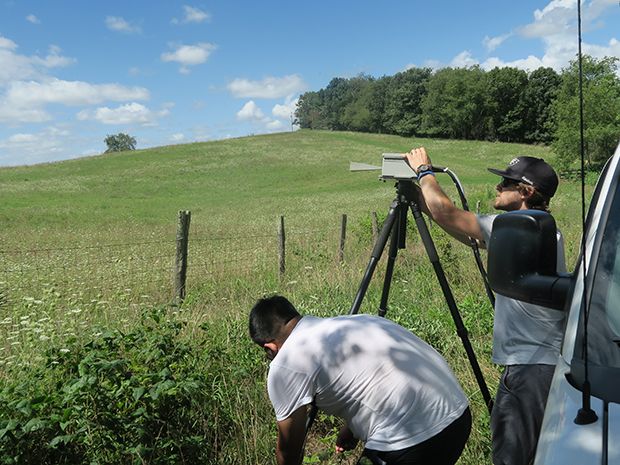
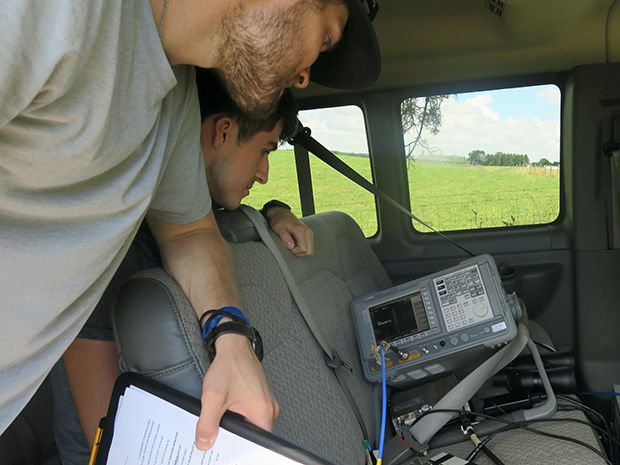
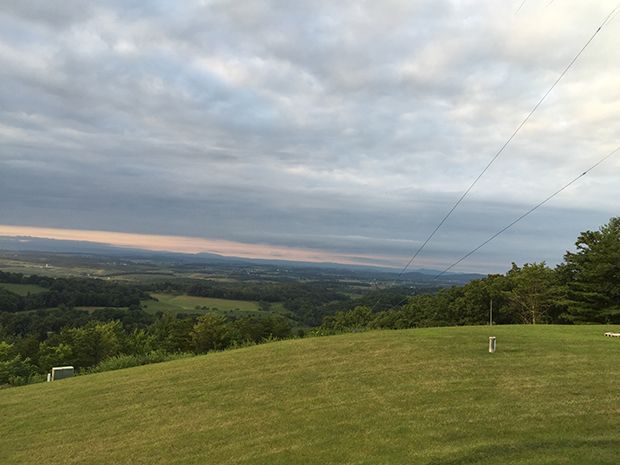 Photo: Ted RappaportThe view from the front porch of Ted Rappaport’s home in Riner, Virginia.